
Tankless vs. Storage Water Heaters: Maintenance Demands Compared
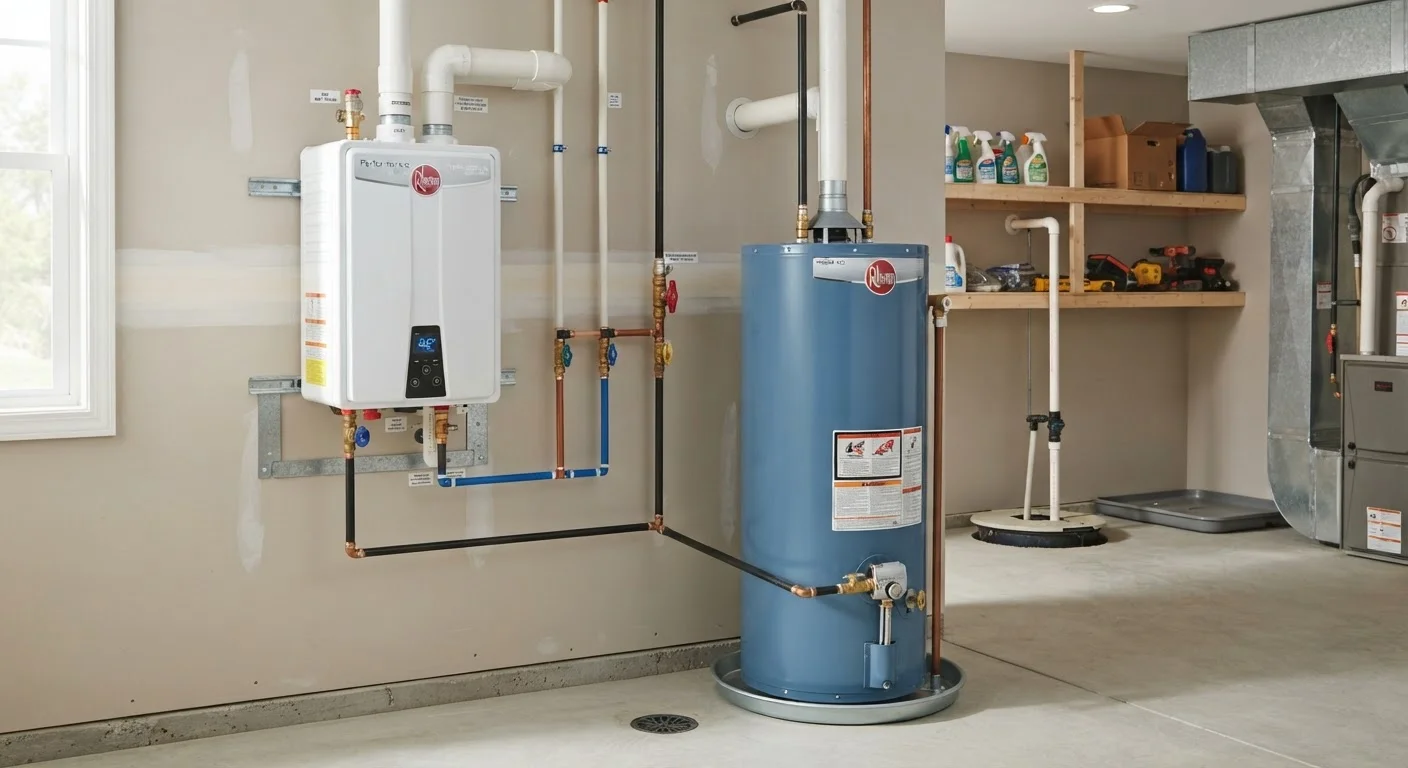
Photo credit: Infolagoon.com | Blogs To Rely On
In this article
Both water heater types require upkeep, but in very different ways. See how their maintenance needs stack up before assuming one is simpler.
Key Takeaways
- Tankless water heaters require annual descaling and filter cleaning, often with professional help.
- Storage tank heaters need regular sediment flushing and anode rod inspection to prevent corrosion.
- Both types benefit from annual professional inspections, especially in hard-water areas.
- Skipping maintenance on either type shortens its lifespan and raises operating costs.
- Tankless units typically last 20+ years with proper care; storage tanks average 8–12 years.
How Each System Works — and Why It Matters for Maintenance
Understanding how your water heater works makes its maintenance requirements easier to follow. A storage tank water heater keeps a large reservoir of water — typically 40 to 80 gallons — continuously heated and ready. A tankless (on-demand) water heater heats water only when a tap or appliance calls for it, passing cold water over a heat exchanger in real time.
These fundamental differences drive entirely different failure modes. The tank unit is vulnerable to internal corrosion and sediment accumulation over years of holding water. The tankless unit is vulnerable to mineral scale clogging its heat exchanger and inlet filter, particularly in regions with hard water. Neither system is maintenance-free — they just require attention in different places.
For a broader picture of where water heater upkeep fits into your home's overall schedule, see our annual home maintenance calendar.
| Criterion | Tankless Water Heater | Storage Tank Water Heater |
|---|---|---|
| Primary maintenance task | Annual descaling of heat exchanger | Annual sediment flush |
| Secondary maintenance task | Inlet filter cleaning (every 6 months) | Anode rod inspection (every 2–3 years) |
| Safety component check | Vent and burner inspection (gas models) | T&P relief valve test (annually) |
| DIY friendliness | Moderate — requires equipment and know-how | High — most tasks need basic tools only |
| Hard-water sensitivity | High — scale clogs heat exchanger quickly | Moderate — sediment settles but tanks tolerate it |
| Typical lifespan (with maintenance) | 20+ years | 8–12 years |
| Professional service frequency | Annually (descaling often requires a plumber) | Every 1–3 years for anode rod and valve checks |
Maintaining a Storage Tank Water Heater
Storage tank maintenance centers on three recurring tasks: flushing sediment, inspecting the anode rod, and testing the pressure relief valve.
Sediment — primarily calcium and magnesium from your water supply — settles at the bottom of the tank over time. It insulates the burner or heating element from the water, reducing efficiency and accelerating corrosion. Flushing the tank annually (or every six months in hard-water regions) removes this buildup. The process involves connecting a hose to the drain valve and running water until it clears. For guidance on this and related plumbing upkeep, see our article on plumbing maintenance tasks you can do without a wrench.
The anode rod is a magnesium or aluminum rod suspended inside the tank that sacrificially corrodes to protect the tank lining. Once depleted, the tank wall begins to rust. Most manufacturers recommend inspecting the rod every two to three years and replacing it when it is significantly degraded — typically under 50% of its original diameter.
Finally, test the temperature and pressure (T&P) relief valve annually. This safety device prevents dangerous over-pressurization. If it fails to operate or leaks afterward, it should be replaced by a licensed plumber.
8–12 years
Average storage tank water heater lifespan
The U.S. Department of Energy notes that regular maintenance — particularly anode rod replacement — is a key factor in reaching the upper end of this range.
20+ years
Typical tankless water heater lifespan
Industry guidance generally cites 20 years or more as achievable for tankless units that receive consistent annual descaling and filter maintenance.
~$150–$250
Estimated professional descaling service cost
Costs vary by region, unit type, and scale severity; this is a general range for budgeting purposes — obtain local quotes for accurate figures.
Maintaining a Tankless Water Heater
Tankless units avoid sediment tanks and anode rods, but their compact heat exchangers are especially sensitive to scale. In areas where water hardness exceeds roughly 120 mg/L (about 7 grains per gallon), scale can accumulate inside the heat exchanger within a single year, reducing flow and heat transfer efficiency.
Annual descaling (flushing with a diluted food-grade white vinegar or purpose-made descaling solution) is the cornerstone of tankless maintenance. This involves isolating the unit, connecting a submersible pump to circulate the solution through the heat exchanger for 45–60 minutes, and then flushing with clean water. Many homeowners hire a plumber for this task, though experienced DIYers with the right equipment can manage it safely.
Most tankless units also have an inlet filter screen that catches debris before it reaches the heat exchanger. This should be rinsed every six months — or more often if your water supply carries sediment.
Gas tankless models additionally require periodic inspection of the venting system and burner for blockages or corrosion. Electric models need their heating elements checked for scale buildup.
Hard Water Accelerates Wear on Both Systems
Water hardness varies significantly across the United States. In areas where hardness exceeds 120–180 mg/L, mineral scale can reduce a tankless heat exchanger's efficiency within a single season, and sediment accumulates faster in storage tanks too. A water test kit — available at most hardware stores — can help you understand your local water chemistry. If your water is particularly hard, discuss treatment options with a licensed plumber before it shortens your heater's service life.
Neglecting maintenance on either heater type leads to real costs. Our piece on the hidden costs of deferred home maintenance explains how skipped upkeep compounds into major repairs.
Which System Demands More of You Over Time?
Measured purely by effort, storage tank heaters require more frequent attention — twice-yearly flushes and periodic anode rod replacements add up. However, most tasks are DIY-friendly and require only basic tools. If you are comfortable with prioritizing maintenance on a budget, a storage tank's low per-task cost makes it accessible.
Tankless maintenance is less frequent but harder to DIY without preparation. Descaling equipment, proper isolation, and knowledge of your unit's specific flush ports are prerequisites. Many homeowners find the annual professional service visit simpler in practice — even if slightly more expensive per occurrence.
In both cases, water quality is the dominant variable. Homes with very hard water should consider a whole-house water softener or conditioner, which reduces maintenance demands for both heater types significantly. This is general information — consult a licensed plumber to assess what is appropriate for your water supply and system.
This article is for general informational purposes only. Always consult a licensed plumbing professional before performing water heater maintenance, especially tasks involving gas lines, pressure relief valves, or electrical components.

Author
Home & Living Editorial Team
Home & Living Editorial Team is the collective byline for our editorial team and contributor network. Articles published under this byline or an editorial pen name are researched, written, and reviewed according to our editorial standards for clarity, consistency, and independence before publication.
View all articles →