
Rush Hour vs. Off-Peak Commuting: Which Strategy Actually Saves Time?
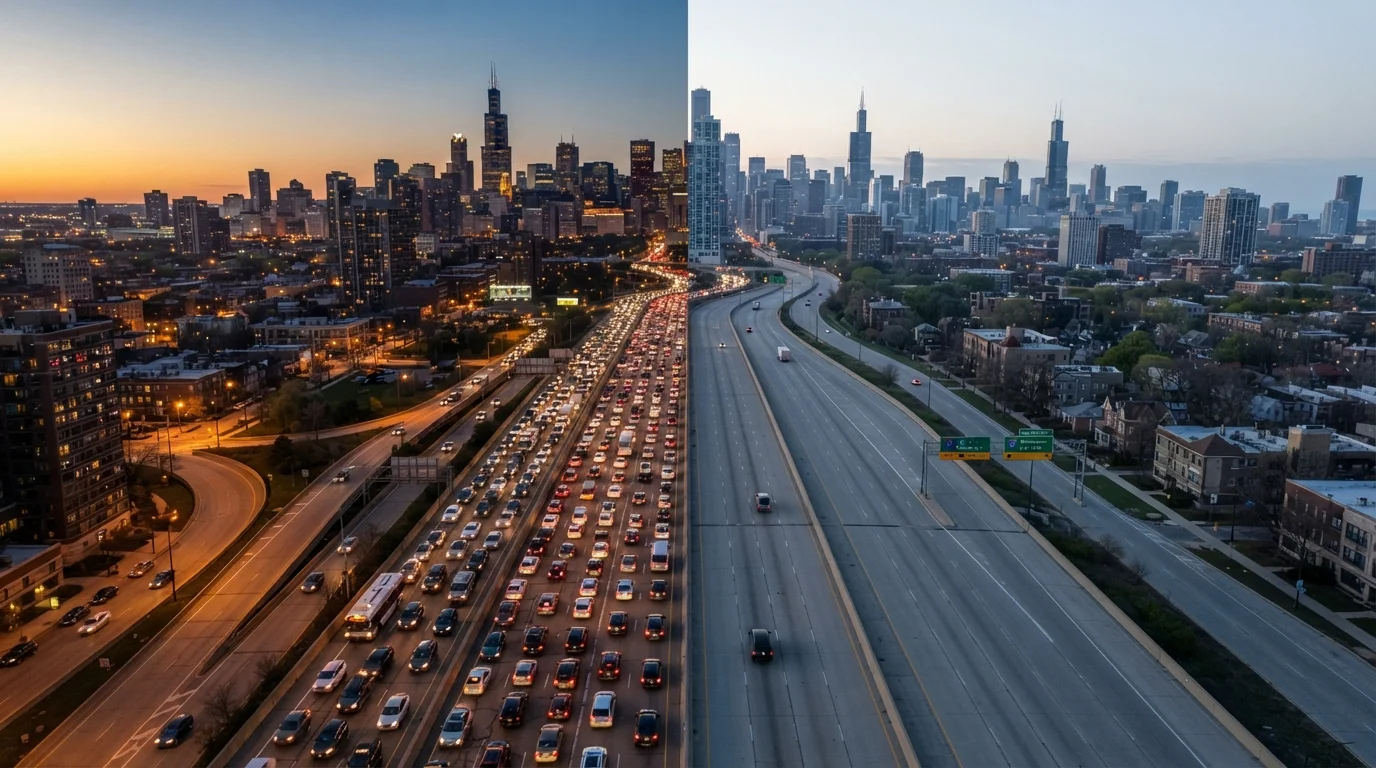
Photo credit: Infolagoon.com | Blogs To Rely On
In this article
Shifting your commute window by even 30 minutes can change everything. Here's what research and traffic data reveal about timing your daily drive.
Key Takeaways
- Shifting your departure by 30-60 minutes outside peak windows can cut commute time by 20-40% on many urban corridors.
- Off-peak driving typically means lower fuel consumption due to less stop-and-go traffic.
- Rush hour commuting offers predictable social rhythms but carries consistent time and stress costs.
- The right strategy depends heavily on employer flexibility, household obligations, and your specific route.
- Traffic data apps can help you identify your corridor's actual peak windows, which vary significantly by city and region.
Why Commute Timing Matters More Than Route
Most commuters spend energy trying to find a faster route. Research suggests the bigger lever is often when you leave, not which roads you take. Traffic volume on major urban corridors can vary dramatically within a single hour - the difference between 7:30 a.m. and 8:30 a.m. departure times can represent tens of minutes on a 20-mile drive.
The Texas A&M Transportation Institute's Urban Mobility Report has consistently found that congestion-related delay adds significant time and fuel cost to peak-hour trips compared to free-flow conditions. While exact figures vary by city and corridor, the direction is consistent: peak hours cost commuters more time per mile than nearly any other variable they can control.
For a fuller picture of what that lost time actually represents financially, see what your commute time is actually costing you.
| Criterion | Rush Hour Commuting | Off-Peak Commuting |
|---|---|---|
| Typical travel time | Longer, often unpredictable | Shorter, more consistent |
| Fuel efficiency | Lower (stop-and-go driving) | Higher (steadier speeds) |
| Vehicle wear | More brake and engine strain | Less wear per mile |
| Schedule alignment | Matches most employer norms | Requires flexibility or negotiation |
| Commute stress | Higher in heavy congestion | Generally lower |
| Travel time predictability | High variance - can spike unexpectedly | Low variance - more reliable |
| Household routine compatibility | Easier for school-run schedules | May require household adjustments |
The Real Costs of Rush Hour
Rush hour commuting is the default for millions of Americans - and its costs are well-documented. Stop-and-go traffic is harder on your fuel economy than steady highway driving. Frequent braking and acceleration cycles wear brake pads faster and can reduce engine efficiency. Beyond vehicle wear, the psychological toll is real: research published in transportation and occupational health journals has linked longer, more congested commutes to elevated stress and lower reported wellbeing.
There is one honest argument for rush hour: social predictability. Arriving and leaving at standard times aligns with most workplaces' expectations, school pickup windows, and household routines. For many workers, that coordination value outweighs the time cost - and that tradeoff is legitimate.
54 hours
Average annual congestion delay per driver in large U.S. metros
According to the Texas A&M Transportation Institute's Urban Mobility Report, peak-period travelers in major metros lose over 50 hours per year to congestion-related delay.
20-40%
Typical travel time reduction when shifting off peak
Navigation data providers including INRIX have reported travel time reductions of this magnitude on high-congestion corridors when departing outside standard peak windows.
~3.6%
Share of U.S. workers with flexible start times
U.S. Bureau of Labor Statistics data indicates that a relatively small proportion of workers have employer-provided schedule flexibility, underscoring why timing strategy remains constrained for many commuters.
If you are locked into peak hours, small adjustments can still help. Reducing fuel use without changing your route is possible through smoother acceleration habits and proper tire pressure - factors that matter more in congestion than on open roads.
What Off-Peak Commuting Actually Delivers
Off-peak commuting - generally defined as departing before 6:30 a.m. or after 9:00 a.m. in the morning, and before 3:30 p.m. or after 7:00 p.m. in the evening - tends to produce faster, more consistent travel times on most American urban corridors. The gains are not marginal: navigation data from platforms like Google Maps and INRIX consistently shows travel time reductions of 20-40% on high-congestion routes when driving outside peak windows.
Fuel savings follow naturally. Highway-speed, steady driving burns less fuel per mile than crawling through gridlock. Over months of commuting, the cumulative difference in fuel costs and vehicle wear can be meaningful, particularly for longer commutes.
Peak Windows Vary by City and Corridor
There is no universal definition of 'off-peak.' In dense metros like Los Angeles or New York, congestion can persist well beyond traditional 8-9 a.m. windows. In smaller cities, a 30-minute shift may be all it takes to move from gridlock to open road. Always check historical traffic data for your specific route before assuming a departure time is clear.
Off-peak commuting also tends to produce a more predictable experience. Peak-hour travel time variance - the unpredictability of whether your 40-minute commute will actually be 40 or 75 minutes - is itself a source of stress. Earlier or later departures compress that variance considerably.
The tradeoff is real, though. Earlier starts mean earlier wake-ups. Later arrivals may conflict with childcare or family commitments. And not every employer offers flex scheduling. Understanding what daily car commuting actually involves across all dimensions - not just time - is worth doing before restructuring your schedule.
How to Identify Your Corridor's Actual Peak Window
Peak hours are not the same everywhere. In a mid-size city, the worst congestion might run from 7:45 to 8:45 a.m. In a major metro, it can stretch from 7:00 to 9:30 a.m. - or longer on certain routes. Using navigation apps that show historical traffic data (not just live conditions) helps you identify when your specific route actually peaks, rather than relying on generic advice.
Most mapping apps allow you to set a future departure time and see estimated travel duration based on historical patterns. Running this comparison for your route - trying 6:30, 7:30, 8:30, and 9:30 a.m. departures - can reveal whether a 30-minute shift meaningfully changes your expected travel time.
Commuting is rarely just about the drive itself. If you share your commute with others, it reshapes the calculus further - see carpooling vs. driving solo for a breakdown of how that choice interacts with timing and flexibility. And if the stress of heavy traffic is a consistent issue, understanding what drives road rage can be a useful complement to any timing strategy you adopt.

Author
Autos & Transport Editorial Team
Autos & Transport Editorial Team is the collective byline for our editorial team and contributor network. Articles published under this byline or an editorial pen name are researched, written, and reviewed according to our editorial standards for clarity, consistency, and independence before publication.
View all articles →