
Oil Change Intervals: What the Numbers on the Sticker Actually Mean
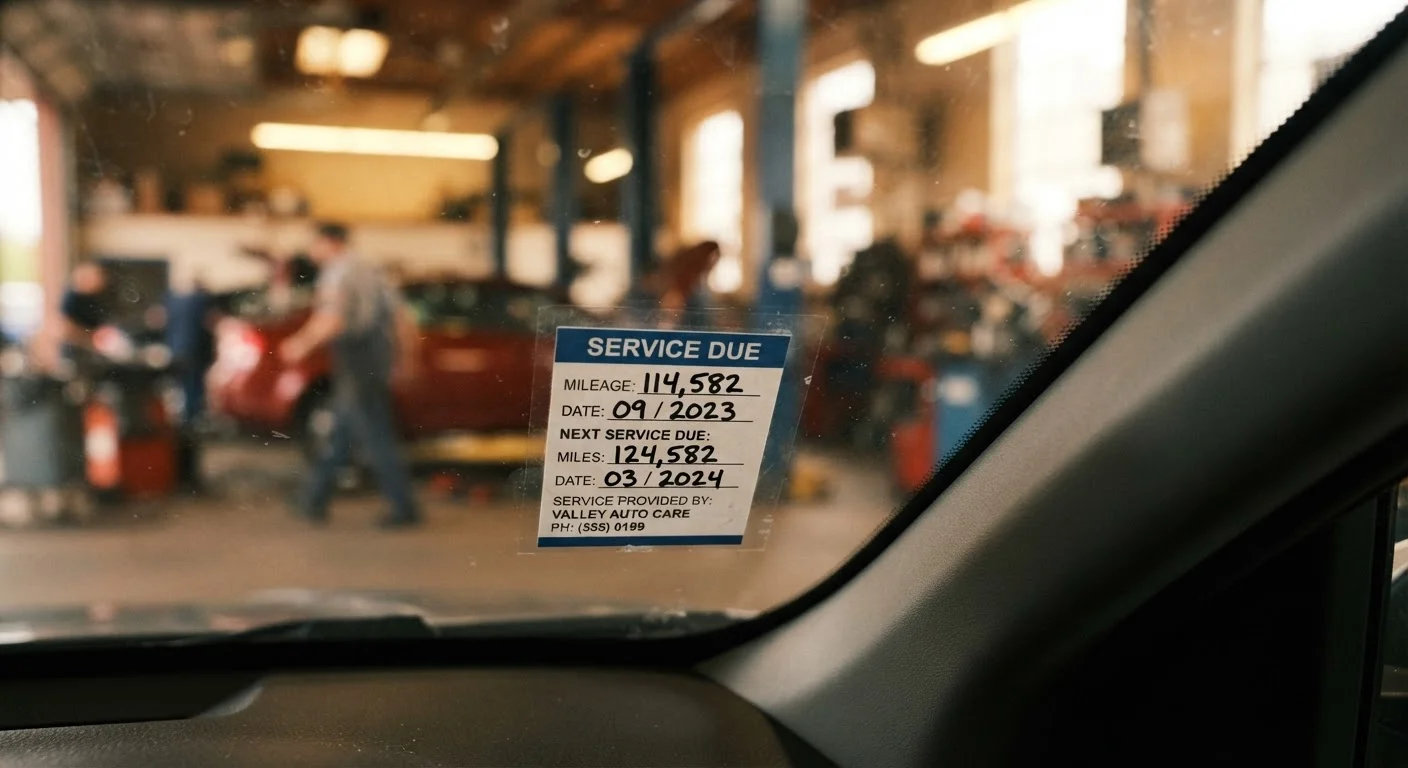
Photo credit: Infolagoon.com | Blogs To Rely On
In this article
That little windshield sticker says 3,000 miles—but is that still accurate? Here's how to read service recommendations the right way.
Key Takeaways
- Modern synthetic oils often allow 7,500-10,000+ mile intervals, far beyond the old 3,000-mile rule.
- Your owner's manual is the most reliable source for your vehicle's specific oil change interval.
- Driving conditions-not just mileage-determine whether you need more frequent oil changes.
- Oil life monitoring systems use real driving data, not guesswork, to alert you when oil needs changing.
- Using the wrong oil viscosity can reduce engine protection regardless of how often you change it.
Where the 3,000-Mile Rule Came From
For decades, a 3,000-mile oil change interval was the standard recommendation plastered on quick-lube stickers across America. That number made sense in the 1970s and early 1980s, when conventional motor oil degraded faster and engine tolerances were less precise. Back then, the guidance was sound engineering advice.
The problem is that the automotive world moved on. Engine metallurgy improved, oil refining technology advanced, and synthetic and synthetic-blend motor oils entered the mainstream. Today's oils are engineered to last significantly longer while maintaining viscosity and protective qualities. Yet the 3,000-mile figure persists largely as a marketing habit rather than a technical standard.
The most accurate source for your vehicle's oil change interval is the owner's manual-not the sticker a shop applied the last time you came in. For a broader look at what service milestones actually mean, see our car maintenance schedule guide.
Myth
You need to change your oil every 3,000 miles, no matter what.
Fact
Most modern vehicles using synthetic oil can safely go 7,500 to 10,000 miles or more between changes, per manufacturer specifications.
The 3,000-mile rule is a holdover from an era of conventional oil and older engine designs. Synthetic motor oils are engineered to maintain viscosity and resist breakdown far longer. Following the 3,000-mile guideline when your car doesn't require it wastes money and produces unnecessary used oil disposal. Always defer to your owner's manual, which reflects the actual tested interval for your engine.
Myth
As long as you change the oil regularly, the type doesn't really matter.
Fact
Using the wrong oil viscosity or specification for your engine can reduce protection and, in some cases, void warranty coverage.
Engines are designed around specific oil viscosity grades - common ones include 0W-20, 5W-30, and 5W-40. These numbers describe how the oil flows at cold start and at operating temperature. Using a thicker or thinner oil than specified can mean inadequate lubrication at startup or insufficient film strength at high temperatures. The owner's manual specifies the correct grade; the oil cap often confirms it too.
Myth
If the oil still looks clean and clear on the dipstick, it doesn't need changing.
Fact
Oil color is not a reliable indicator of its remaining protective capacity or the presence of harmful additives depletion.
Synthetic oils, in particular, can look nearly transparent long after their additive packages - which neutralize acids and prevent sludge - have been depleted. Dark oil isn't automatically bad; some oils darken quickly by design as they pick up combustion particles. The dipstick tells you the oil level and gives a rough visual check, but it can't tell you about additive depletion or contamination. Trust your mileage interval or oil life monitor instead.
Myth
The sticker the shop put on your windshield is the official service recommendation.
Fact
Windshield stickers reflect the shop's default interval, not necessarily your vehicle manufacturer's actual specification.
Quick-lube and service shops typically set sticker intervals based on their standard service cycle - often 3,000 or 5,000 miles - applied uniformly across all vehicles. Your manufacturer's recommendation may be significantly longer. The sticker is a convenience reminder, not an engineering document. Use it as a prompt to check your actual interval rather than an instruction to follow literally.
Myth
Switching from conventional to synthetic oil will cause leaks in an older engine.
Fact
Modern synthetic oils do not cause seals to shrink or degrade in properly maintained engines, and switching is generally safe.
This myth dates to early synthetic formulations that used different base chemicals. Today's full synthetic oils are compatible with modern seal materials. That said, if an older engine already has worn or cracked seals that were being 'swelled' by conventional oil additives, switching could reveal pre-existing leaks rather than create new ones. If you're managing a high-mileage vehicle, it's worth checking the current seal condition before making the switch and consulting your shop if you're uncertain.
What 'Severe' vs. 'Normal' Driving Really Means
Most owner's manuals include two service schedules: one for normal driving and one for severe or extreme conditions. Many drivers assume they fall into the normal category, but the industry definition of severe driving is broader than you'd expect.
Severe driving includes frequent short trips under five miles, stop-and-go city traffic, towing or hauling heavy loads, driving in extreme heat or cold, and extended idling. If any of those describe your typical week, the shorter interval applies to you-even if your car otherwise runs perfectly.
Short Trips Are Harder on Oil Than Long Ones
If most of your driving involves trips under five miles, your oil degrades faster than the mileage count suggests. The engine never fully heats up, so moisture and combustion acids accumulate in the oil. If this describes your routine, consider the shorter interval in your owner's manual's severe-use schedule.
Short trips are particularly hard on oil because the engine never fully reaches operating temperature. That means condensation and combustion byproducts accumulate in the oil rather than burning off, accelerating degradation faster than mileage alone would suggest. To keep the full picture of your engine's health in view, it helps to know how to check your fluids between service visits.
Understanding Your Oil Life Monitor
Many vehicles made in the past 15 years include an oil life monitoring system (OLMS). This isn't a timer or a simple mileage counter - it's an algorithm that tracks engine temperature, RPM patterns, load, and trip length to calculate how much useful life remains in your oil.
7,500-10,000 mi
Typical synthetic oil change interval
Many major automakers specify full synthetic oil change intervals of 7,500 to 10,000 miles or more in their owner's manuals for normal driving conditions.
~40%
Drivers who change oil too frequently
Studies by the California Department of Resources Recycling and Recovery have found a significant share of drivers change their oil more often than their vehicle actually requires, generating unnecessary waste.
When the monitor displays a percentage, it reflects that algorithmic estimate. A reading of 40% means the system calculates your oil still has roughly 40% of its protective capacity left. You don't need to change it immediately at that point, but you should plan the service. Most manufacturers recommend changing before the monitor drops below 15-20%.
One important caveat: the oil life monitor doesn't detect a mechanical problem that's contaminating your oil-such as a coolant leak or excessive fuel dilution. If you notice oil that looks milky, smells strongly of fuel, or your dashboard warning lights are signaling trouble, don't wait for the monitor to prompt a change.
Getting Intervals Right for Your Specific Vehicle
There's no single number that fits every driver. A newer vehicle running full synthetic oil under light highway conditions may comfortably go 10,000 miles between changes. An older engine with conventional oil doing daily short-trip city driving may legitimately need changes closer to 5,000 miles. High-mileage vehicles add another layer of consideration - maintenance priorities shift after 100,000 miles, and oil type and interval choices matter more as seals and tolerances age.
Always Use the Oil Grade Your Manufacturer Specifies
Substituting a different viscosity grade to save a few dollars or because it was on the shelf can reduce engine protection. Modern engines are precisely calibrated for specific oil grades. Using the wrong one - even temporarily - puts more stress on bearings and other critical surfaces, particularly at cold startup. Check your owner's manual or the oil cap for the correct specification before every change.
The practical approach: look up your model year's recommendation in the owner's manual, use the oil grade specified, and if your car has an oil life monitor, follow it. If it doesn't, apply the appropriate schedule based on your driving conditions. Keeping a simple log of oil changes - date, mileage, and oil type - takes 30 seconds and removes any guesswork about when you're due.

Author
Autos & Transport Editorial Team
Autos & Transport Editorial Team is the collective byline for our editorial team and contributor network. Articles published under this byline or an editorial pen name are researched, written, and reviewed according to our editorial standards for clarity, consistency, and independence before publication.
View all articles →