
How to Organize a Small Kitchen Without Losing Counter Space
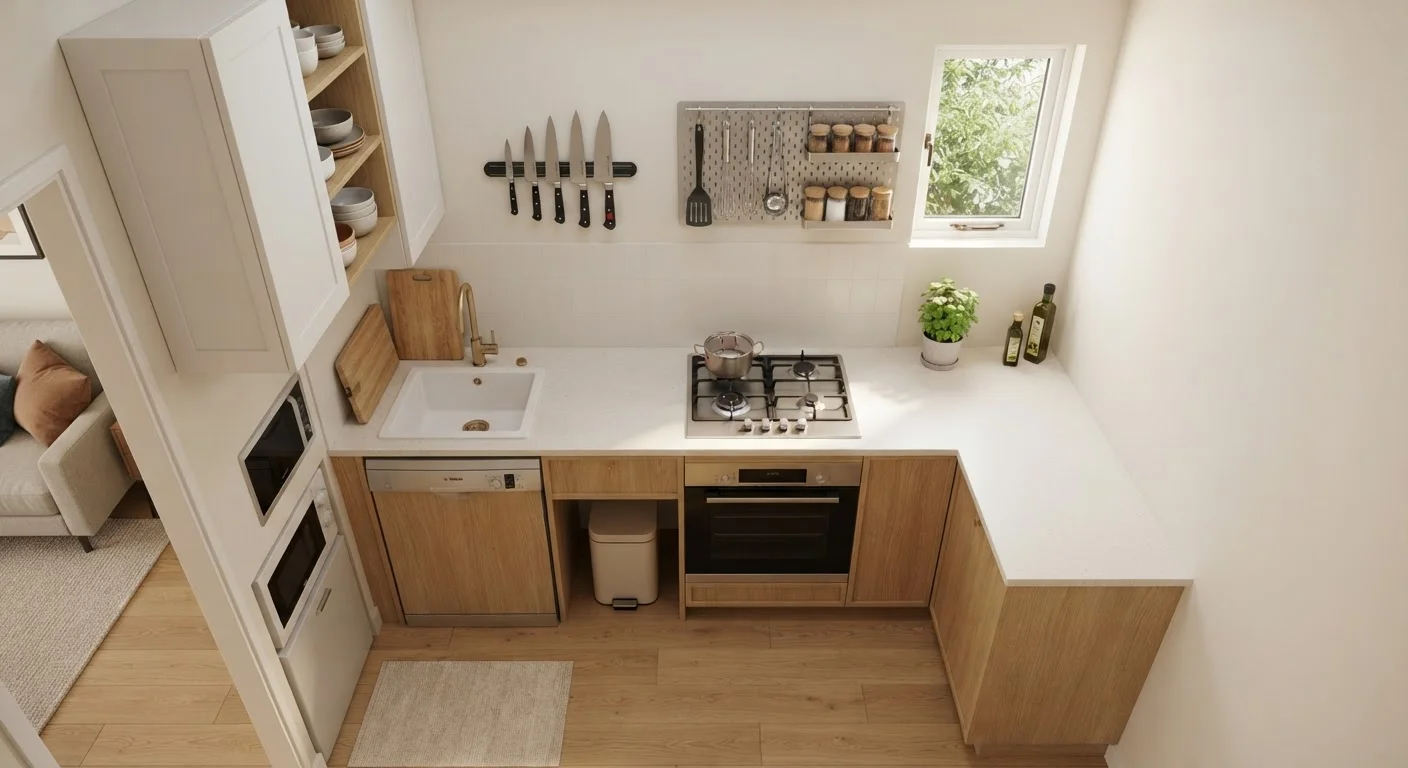
Photo credit: Infolagoon.com | Blogs To Rely On
In this article
Small kitchens demand smarter systems. Learn practical ways to store cookware, pantry items, and utensils without crowding your workspace.
Key Takeaways
- Vertical wall space is one of the most underused storage assets in a small kitchen.
- Decluttering before organizing prevents you from building systems around things you don't need.
- Grouping items by task — not by type — reduces the time you spend searching while cooking.
- Drawer organizers and stackable containers recover lost space inside cabinets and drawers.
- Keeping countertops clear requires intentional rules about what lives there permanently.
Why Small Kitchens Need Systems, Not More Storage
The common instinct in a small kitchen is to buy more storage — extra shelving units, rolling carts, hanging racks. But more storage without a clear system often just means more places for clutter to accumulate. The real problem in most small kitchens isn't a lack of space; it's that the available space isn't being used intentionally.
A functional small kitchen is built on two principles: keeping only what you use regularly, and placing every item close to where it's needed. These principles are straightforward, but applying them requires working through the space methodically. The steps below walk you through that process.
If your kitchen is shared with others who have different habits, the organizational system you set up will need to be agreed on together — see organizing a home with multiple people for practical guidance on that dynamic.
Declutter Before You Organize
Organizing items you no longer need wastes time and space. Before rearranging anything, remove duplicates, expired pantry goods, and gadgets you haven't touched in over a year. A smaller, curated collection of kitchen items is almost always easier to manage than a complete one.
Before you buy a single organizer or hook, work through the steps below to understand what you're actually organizing and where your space is being lost.
What you will need
What You'll Need
Most of the tools that help the most in a small kitchen are inexpensive and widely available. Here's what tends to make the biggest difference:
Stackable shelf risers
Double the usable vertical space inside cabinets for plates, bowls, or canned goods.
Drawer dividers or organizers
Keep utensil and junk drawers sorted so items don't pile and become hard to find.
Magnetic knife strip
Mounts on the wall to store knives safely and free up an entire drawer or counter block.
Over-door organizers
Add storage to the inside of cabinet or pantry doors for spices, foil, or cleaning supplies.
Clear airtight containers
Standardize pantry storage so containers stack efficiently and contents are visible at a glance.
Tension rods
Create vertical dividers inside deep cabinets to store baking sheets and cutting boards upright.
You don't need all of these at once. Start with the keep-versus-discard pass and the zoning step before buying anything — you may find you need less than you think.
Step-by-Step: Organizing Your Small Kitchen
Empty and edit every cabinet and drawer
Pull everything out of your cabinets, drawers, and pantry — all at once if possible, or one zone at a time. As you remove items, sort them into three groups: keep, donate, and discard. Be honest about what you actually use. A countertop appliance you've used twice in two years is clutter, not a kitchen tool.
Once you've pared down, clean the empty shelves and drawers before putting anything back.
Map out your kitchen zones
Divide your kitchen into functional zones: prep, cooking, storage, and clean-up. Each item you kept should live in the zone where it's used. Pots and pans belong near the stove. Cutting boards and prep bowls belong near your main workspace. This single shift reduces how much you move around while cooking and keeps surfaces cleaner.
Go vertical inside your cabinets
Most kitchen cabinets have more vertical height than you're using. Add stackable shelf risers to create two levels inside a single cabinet — ideal for plates, mugs, or canned goods. Use tension rods vertically inside deep lower cabinets to store baking sheets, cutting boards, and lids upright rather than stacked flat.
The goal is to see everything in a single glance without having to unstack or dig.
Claim wall and door space
Walls and the insides of cabinet doors are free real estate in a small kitchen. A magnetic knife strip on the wall frees up an entire drawer. Over-door organizers inside a pantry or cabinet door hold spices, foil, and plastic wrap without using any shelf space.
A pegboard section above a prep area can hold frequently used tools like spatulas, ladles, and measuring cups — keeping them off the counter and within easy reach.
Standardize your pantry with uniform containers
Decanting dry goods — pasta, rice, flour, oats — into clear, airtight containers of similar sizes lets them stack efficiently and makes quantities immediately visible. Irregular packaging (bags of different sizes, half-used boxes) wastes shelf space and makes it harder to take inventory quickly.
Label containers clearly, including the date of the original package if freshness matters.
Set rules for what lives on the counter
Countertops should hold only items used daily — a coffee maker, a knife block (or replace it with a wall strip), a dish drying rack if you have no other option. Everything else should have a home in a cabinet or drawer. The counter rule is simple: if you don't use it every day, it doesn't earn permanent counter space.
Once you've established this, it becomes the standard your kitchen resets to, rather than a constant source of clutter.
Zone Your Kitchen Like a Pro
Think in cooking zones: prep area, cooking area, and clean-up area. Store items closest to where they're used — cutting boards near the prep zone, pot holders near the stove, dish soap near the sink. This reduces unnecessary movement and keeps counters clear of out-of-place clutter.
For a closer look at one of the trickiest spots in any kitchen, the junk drawer organization guide covers how to sort and maintain a genuinely useful miscellaneous space.
Keeping It Organized Over Time
The most common reason kitchen organization systems fail is that the reset habit never forms. Once a week — or even once a month — take five minutes to return items to their designated zones, check the pantry for things that need restocking or discarding, and clear the counter back to its baseline.
If you find yourself constantly fighting the same clutter spots, that's a signal the system needs adjusting, not that organization doesn't work. Sometimes a zone is in the wrong place, or a cabinet is awkward enough that no one uses it correctly. Treat it as a practical problem to solve, not a discipline failure.
For a broader look at how open shelving versus concealed storage affects how easy a space is to maintain, the trade-offs of invisible storage vs. open shelving offers an honest breakdown of both approaches.
Don't Overload Cabinet Doors or Shelves
Adhesive hooks and over-door organizers have weight limits — check the manufacturer's guidance before loading them up. Overloaded cabinet doors can warp hinges or pull away from the surface over time, leading to repairs that outweigh the storage benefit.

Author
Home & Living Editorial Team
Home & Living Editorial Team is the collective byline for our editorial team and contributor network. Articles published under this byline or an editorial pen name are researched, written, and reviewed according to our editorial standards for clarity, consistency, and independence before publication.
View all articles →