
City Driving vs. Highway Driving: Why the Skills Are More Different Than You Think
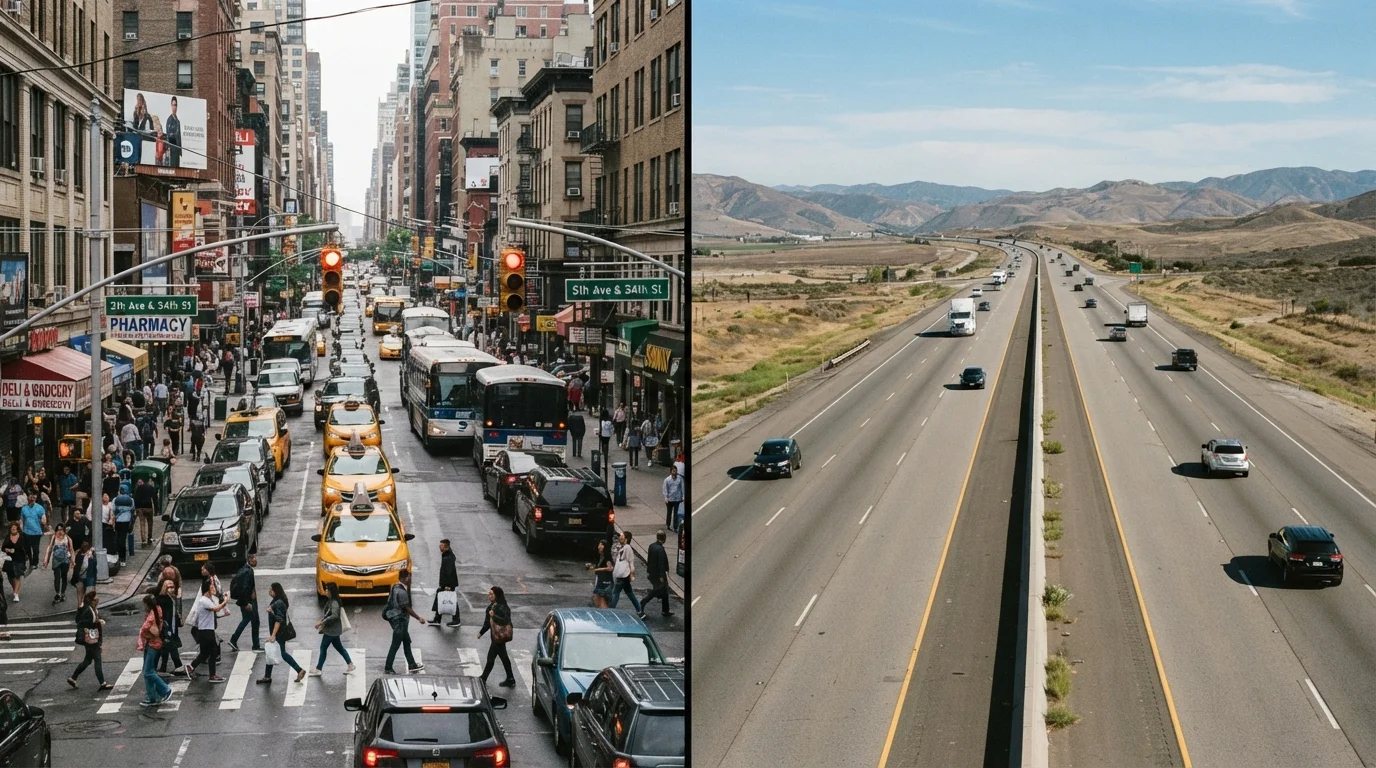
Photo credit: Infolagoon.com | Blogs To Rely On
In this article
Urban stop-and-go and open highway travel demand distinct habits and awareness. Here's a side-by-side look at what each environment actually requires.
Key Takeaways
- City driving demands constant, short-range decision-making; highway driving requires sustained attention over longer distances.
- Stop-and-go urban traffic wears down brakes and fuel efficiency faster than steady highway cruising.
- Highway hypnosis is a genuine cognitive risk on long stretches - city driving rarely triggers the same mental fade.
- Merging, lane positioning, and following distance work differently at highway speeds than in urban environments.
- Most drivers default to habits built in one environment and underestimate how much adjustment the other requires.
Why the Distinction Actually Matters
Most licensed drivers learn the basics of both environments and then assume the skills transfer automatically. They largely don't. City driving and highway driving place fundamentally different cognitive and physical demands on the person behind the wheel - and mismatched habits are a quiet contributor to collisions, unnecessary wear on your vehicle, and elevated commute stress.
If you've ever felt oddly tense pulling off a highway after a long drive, or found yourself spacing out during stop-and-go traffic, those reactions are your nervous system responding to very different driving environments. Understanding the contrast can help you drive more deliberately in both. For a broader look at what daily driving actually costs you, see our piece on what long-term car commuting involves.
How City Driving Works Your Brain and Body Differently
Urban driving is cognitively dense. Within a single city block, a driver might process traffic signals, pedestrian crossings, cyclists, double-parked vehicles, merging buses, and sudden brake lights - often simultaneously. That compressed decision-making cycle keeps your working memory constantly loaded.
The pace is stop-and-go rather than continuous, which means you're constantly modulating throttle and brake. This has real mechanical consequences: urban driving is harder on brake pads and rotors, and repeated short-trip cycles are tougher on engines that never fully reach operating temperature. Fuel economy is also notably lower in city conditions because of the idling and frequent acceleration.
Stress tends to run higher in urban environments. Unpredictability is the norm - a pedestrian steps off a curb, a delivery van pulls out mid-block, a cyclist cuts across a lane. Good city driving is about maintaining a wide, close-range awareness field and keeping a buffer around your vehicle even when space is tight.
Reset Your Awareness When Switching Environments
When you move from a long highway stretch into city traffic, give yourself a deliberate mental reset at the transition point - an on-ramp, a toll plaza, or a city limits sign works well. Consciously narrow your visual focus to close-range and anticipate lateral movement from all directions. The habits that serve you at 65 mph can actively work against you at 25 mph in dense traffic.
For a grounded look at managing urban commute tension specifically, our guide on defensive driving principles covers the core habits that reduce risk in high-density traffic.
What Highway Driving Actually Demands
Highway driving looks easier - fewer intersections, no pedestrians, smoother pavement. But that simplicity creates its own hazard. Monotony reduces mental arousal, and reduced arousal means slower reaction times. Highway hypnosis - a real phenomenon where drivers cover long distances without conscious awareness - is a documented cognitive risk, not just a figure of speech. Our article on highway hypnosis and how to stay alert goes into the mechanics of why it happens and who's most vulnerable.
At highway speeds, the consequences of errors scale up sharply. A one-second lapse at 70 mph means traveling over 100 feet without active input. Following distance, lane-change judgment, and merge timing all operate on a different physics than city driving. The three-second following rule that works in a city should be extended at highway speeds, particularly in adverse conditions.
Highway driving also demands a longer visual horizon - scanning further ahead rather than fixating on the vehicle immediately in front. Drivers who habitually scan close-range in urban environments often bring that same short focus to the highway, which reduces their ability to anticipate lane changes or slowdowns ahead.
| City Driving | Highway Driving | |
|---|---|---|
| Primary cognitive demand | Constant short-range decision-making | Sustained attention, resisting monotony |
| Speed and pace | Frequent stops, low average speed | Steady high speed, fewer inputs |
| Main safety risk | Unpredictable pedestrians and cyclists | Reduced alertness, high-speed errors |
| Following distance | Tight gaps, frequent adjustments | Extended gaps required at speed |
| Fuel economy impact | Lower MPG due to idling and acceleration | Generally higher MPG at steady speeds |
| Brake and component wear | Higher - frequent braking cycles | Lower - sustained cruising speed |
| Visual scan range | Close-range, wide lateral awareness | Far-horizon scanning, narrower lateral |
Vehicle Wear and Fuel: The Practical Difference
The environment you drive in has a direct impact on how quickly components wear and how much fuel you consume. City driving's stop-and-go cycle burns more fuel per mile, stresses the braking system more frequently, and can shorten the life of transmission components in vehicles with automatic gearboxes that shift repeatedly at low speeds.
Highway driving, by contrast, tends to be gentler on most mechanical systems when speeds are steady - but it puts more mileage on tires and can accelerate engine wear differently if cruise control encourages long periods without subtle speed variation. If you share commute miles with others, carpooling vs. driving solo examines how combining trips affects these costs over time.
Don't Carry Highway Habits Into City Streets
Drivers who've spent an hour or more on the highway often arrive in city traffic still operating at highway reaction expectations - longer following distances feel unnecessary, and slower scanning feels excessive. This transition lag is a real risk factor. Research on driver adaptation suggests it can take several minutes to fully recalibrate to a new driving environment, so ease into urban conditions rather than diving into complex intersections immediately after exiting a highway.
Translating These Differences Into Better Habits
Recognizing the gap between city and highway demands gives you a practical edge. When transitioning from highway to city driving, consciously reset your scan radius - bring your attention closer and anticipate more lateral movement. When transitioning the other way, actively extend your following distance and resist the urge to stay glued to the bumper ahead.
Weather adds another variable to both environments. Wet and low-visibility conditions change the rules in both settings, but the risks manifest differently - urban hydroplaning at lower speeds versus highway skids at higher ones.
Building a commute routine that accounts for the specific environment you're entering - rather than treating all driving as interchangeable - is what separates reactive drivers from deliberate ones. Our guide on building a smarter daily commute routine offers a structured framework for doing exactly that.

Author
Autos & Transport Editorial Team
Autos & Transport Editorial Team is the collective byline for our editorial team and contributor network. Articles published under this byline or an editorial pen name are researched, written, and reviewed according to our editorial standards for clarity, consistency, and independence before publication.
View all articles →