
Nutrition Traps Hidden in 'Healthy' Food Marketing
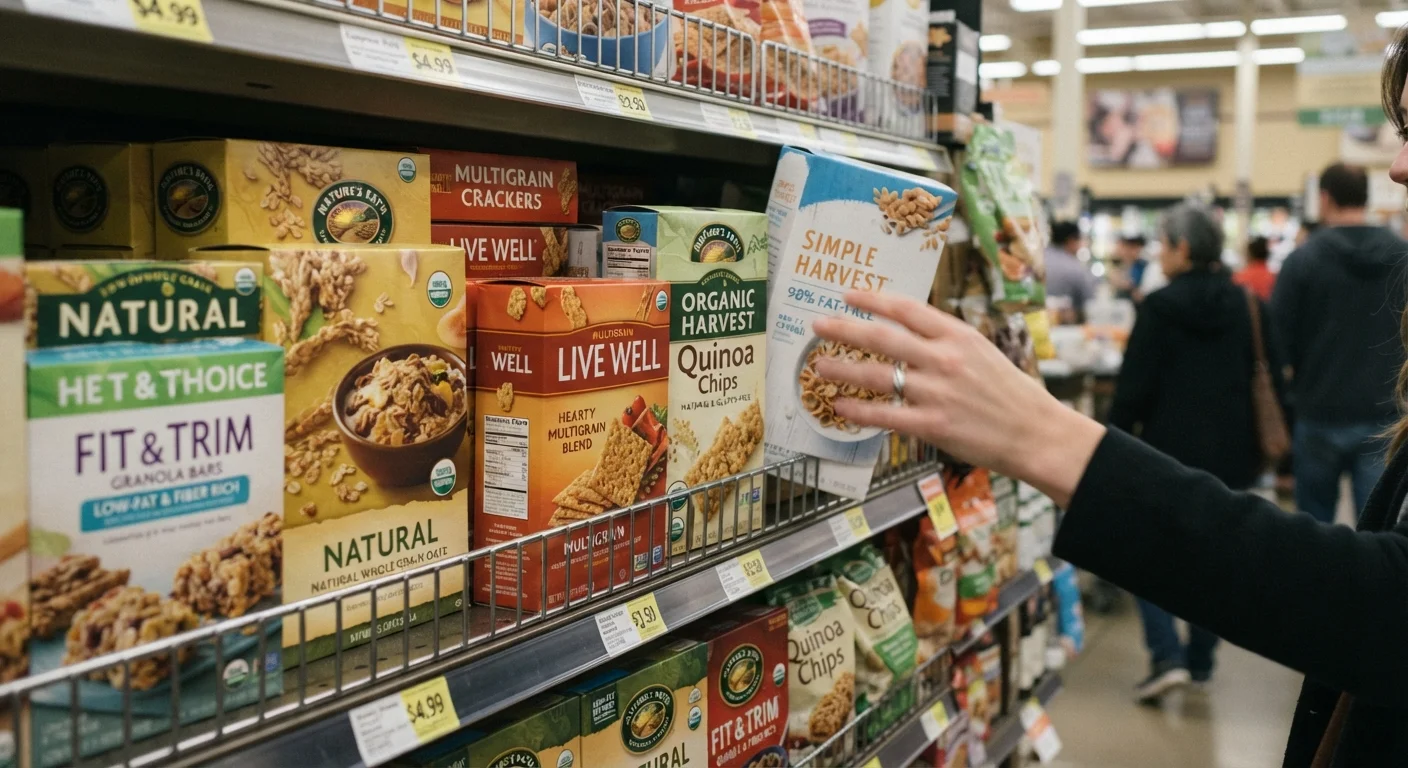
Photo credit: Infolagoon.com | Blogs To Rely On
Terms like 'natural,' 'low-fat,' and 'multigrain' sound reassuring—here's what they legally mean and where they can mislead shoppers.
Key Takeaways
- Terms like 'natural' and 'multigrain' carry no strict nutritional standard under FDA rules.
- Low-fat products often compensate with added sugar or sodium to maintain flavor.
- The Nutrition Facts panel and ingredients list are more reliable guides than front-of-pack claims.
- Serving size manipulation can make a product appear far healthier than it is.
- Whole grain must appear as the first ingredient to indicate a meaningfully grain-rich product.
- Always check total sugar, fiber, and sodium rather than relying on a single health claim.
Why 'Healthy' Labels Deserve a Second Look
Walking a grocery aisle, it's easy to assume that words like "natural," "light," or "multigrain" signal a nutritious choice. Food manufacturers invest heavily in front-of-package claims precisely because they work - research consistently shows shoppers perceive labeled products as healthier, even without reading the Nutrition Facts panel.
The problem is that many of these terms are either loosely defined, entirely unregulated, or legally meaningful in ways that don't match everyday expectations. Understanding the gap between marketing language and nutritional reality is one of the most practical skills a grocery shopper can develop. For a solid foundation, our guide to reading a Nutrition Facts label walks through every section of the panel clearly.
Below are the most common nutrition traps hiding behind reassuring packaging - and what to look for instead.
'Natural' Has No FDA Nutritional Definition
The U.S. Food and Drug Administration has historically not defined the term "natural" for most food products. The agency's informal policy has generally allowed the word when a food contains no added color, artificial flavors, or synthetic substances - but this says nothing about sugar content, processing level, sodium, or overall nutritional quality.
A product labeled "natural" can contain high-fructose corn syrup, be heavily processed, and be high in sodium. The label simply does not promise what most shoppers assume it does. When evaluating a product, ignore "natural" entirely and focus on the ingredients list and Nutrition Facts panel instead.
'Natural' tells you almost nothing about a product's actual nutritional quality.
'Low-Fat' Often Means More Sugar or Sodium
When fat is removed from food, flavor and texture go with it. To compensate, manufacturers commonly add sugar, refined starch, or sodium. This means a low-fat yogurt or salad dressing can carry more added sugar than the full-fat version - and studies suggest excess added sugar poses its own health concerns independent of fat intake.
The "low-fat" claim is also technically defined: the FDA requires fewer than 3 grams of total fat per serving. But a small serving size can make a product qualify even when a realistic portion is much larger. Check the added sugar row on the label any time you reach for a low-fat product.
Removing fat often means adding sugar - always check both on the label.
'Multigrain' Is Not the Same as 'Whole Grain'
Multigrain simply means a product contains more than one type of grain. Those grains may all be refined - stripped of the bran and germ that carry fiber, B vitamins, and minerals. A multigrain bread can have almost no meaningful fiber and a high glycemic load.
Whole grain, by contrast, requires that the entire grain kernel be present. For a product to be meaningfully whole-grain, look for a whole grain (such as "whole wheat" or "whole oats") as the first ingredient on the list. Our article on what changes when grains are refined explains exactly what's lost in processing.
Multigrain products can be made entirely from refined grains - check the first ingredient.
Serving Sizes Can Be Set Deceptively Small
Manufacturers set their own serving sizes within FDA guidelines, and a realistic portion may be two or three times the listed serving. A bag of chips might list 140 calories per serving - but if the serving is only 1 oz and the bag contains 3.5 oz, the actual calories consumed in one sitting could exceed 490.
This affects every figure on the panel: sodium, sugar, fat, and fiber all scale with the serving. The FDA updated its serving-size rules in recent years to require that stated servings better reflect amounts people actually eat, but variation still exists. Always note the servings-per-container figure at the top of the Nutrition Facts panel before reading any other number.
The entire Nutrition Facts panel is only meaningful once you know the realistic serving.
'Light' Can Refer to Color, Flavor, or Calories
"Light" (or "lite") has multiple legal definitions under FDA rules depending on context. It can mean the product has one-third fewer calories or half the fat of a reference food - or it can simply describe a lighter color or milder taste, with no nutritional implication at all. "Light olive oil," for example, refers to a lighter flavor profile; it contains the same calories as regular olive oil.
When "light" is used as a nutritional claim, the reference food matters. A product that is "33% fewer calories" than an already calorie-dense original is not necessarily a low-calorie food. Read the actual calorie count rather than relying on the comparative claim.
'Light' can legally describe taste or color - not necessarily fewer calories.
'High in Protein' Doesn't Guarantee a Balanced Food
Protein marketing has grown substantially, and "high protein" bars, cereals, and snacks now crowd most aisles. While adequate protein intake is genuinely important - see our overview of protein sources across eating patterns - a product being high in protein does not make it nutritionally complete or low in other concern nutrients.
Many high-protein packaged foods contain significant added sugar, saturated fat, or artificial additives to achieve palatability. The FDA requires at least 10 grams of protein per serving for a "good source of protein" claim. Evaluate what else comes alongside that protein before treating the product as a health food.
A high-protein label says nothing about added sugar, saturated fat, or overall quality.
'No Added Sugar' Still Allows Naturally Occurring Sugars - and Sugar Alcohols
"No added sugar" means no sugars were introduced during processing - but the product can still contain substantial naturally occurring sugars from fruit, dairy, or other ingredients. A no-added-sugar fruit juice can carry as much total sugar as a soft drink.
Additionally, many no-added-sugar products use sugar alcohols (such as erythritol, xylitol, or maltitol) as sweeteners. These are not counted as added sugars, but some sugar alcohols cause digestive discomfort in larger amounts. Check the total sugars row and the ingredients list for sugar alcohol names ending in "-ol" when evaluating these products.
No added sugar doesn't mean low sugar - naturally occurring sugars can still be abundant.
Making Smarter Choices at the Store
The most reliable strategy is to treat front-of-package claims as advertising - interesting, but not decisive. Flip every product over and spend fifteen seconds on three things: the serving size, the ingredients list, and the amounts of added sugar, sodium, and fiber.
A Quick Shelf-Side Habit That Helps
Before placing any packaged food in your cart, flip it over and check three things in order: the serving size, the added sugars, and the first two or three ingredients. This fifteen-second habit cuts through most front-of-package marketing. If the ingredients list is long and unfamiliar, that's useful information regardless of what the front label says.
If you want to understand how your food choices fit into a broader eating pattern, exploring what carbs, protein, and fat actually do in your body and why fiber matters can add useful context. Similarly, understanding added versus natural sugar on a label helps decode sweet-sounding claims in an instant.
This article is for general informational and educational purposes only. It is not a substitute for advice from a registered dietitian or qualified healthcare professional. Individual nutritional needs vary; consult a professional before making significant changes to your diet.

Author
Health & Wellness Editorial Team
Health & Wellness Editorial Team is the collective byline for our editorial team and contributor network. Articles published under this byline or an editorial pen name are researched, written, and reviewed according to our editorial standards for clarity, consistency, and independence before publication.
View all articles →